Sound Design · LOOK AGAIN.
Sound Design Feedback Guide & Checklist
A structured way to listen to a mix and say something useful about it. Ten concepts, each with a short checklist of what to listen for and a 1 to 5 rating scale, so “the sound is off” becomes a note the sound designer can act on.
10 concepts · PDF + online edition · €15€8.99 one-time · VAT calculated at checkout
Who it’s for
Built for anyone giving or getting notes on a mix.
EVALA is a feedback framework for creative work.
This edition applies it to sound design.
Sound designers and mixers reviewing their own work
Step back from a mix you have played on loop and check it against ten specific questions.
Directors, editors and producers giving notes
Put a reaction into words the sound team can work with: what you heard, which concept it belongs to, and how strong it is.
Students and teachers
A shared vocabulary for critiquing a mix in class, with a rating scale that makes the discussion concrete.
What it evaluates
Ten concepts, one for each choice in a mix.
From whether the sound serves the story to how it sits in the room.
Each concept has its own checklist and 1 to 5 rating scale.
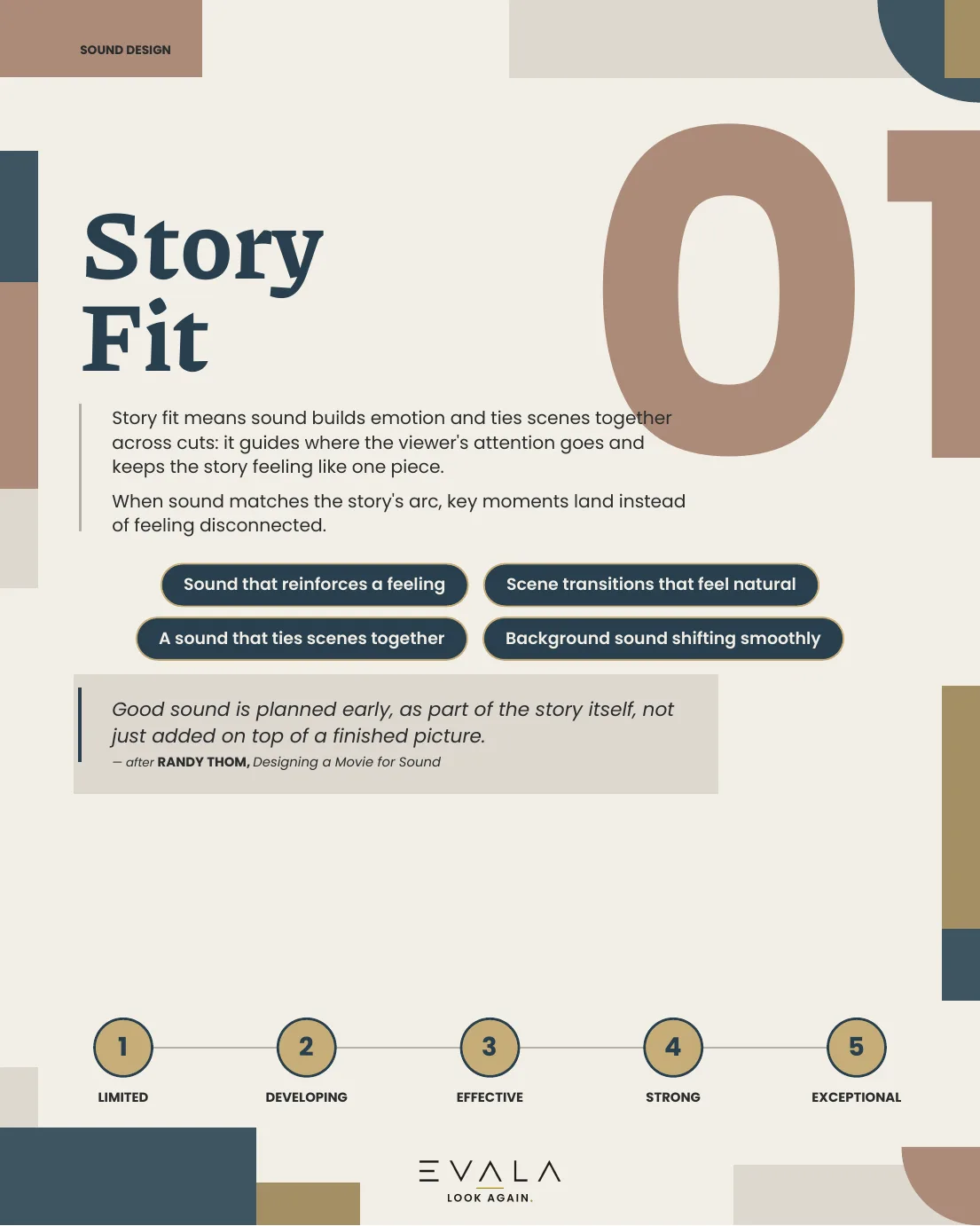
- 01Story Fit free sample
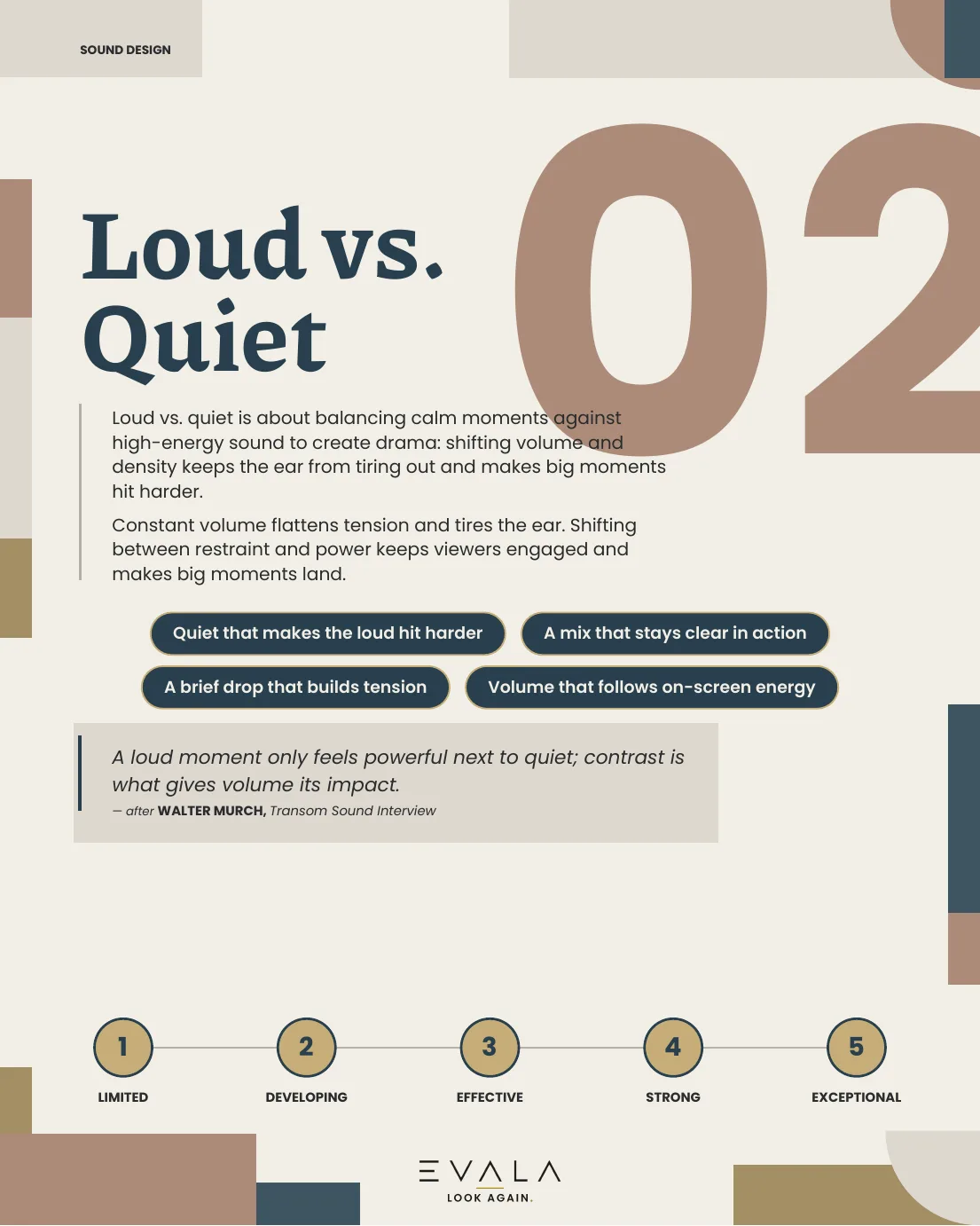
- 02Loud vs. Quiet free sample
- 03Room Sound
- 04Timing & Rhythm
- 05Voice Clarity
- 06Background Atmosphere
- 07Foley Sync
- 08Punchy Impacts
- 09Offscreen Sound
- 10Surround Placement
Free sample
The first two concepts, straight from the guide.
This is what every concept page looks like. Click a page to view it full size.
In practice
From vague reaction to useful note.
The guide gives you the words for what you noticed. Here is one note, before and after. It is an illustration, not a real client note.
The vague note
“It’s too loud.”
With the guide
- Name the concept. This falls under Loud vs. Quiet.
- Check the list. “A quiet passage that makes the next loud beat hit harder.” The whole scene plays at one level, so the explosion has nothing to rise from.
- Rate it. 1 out of 5: nonstop loud volume exhausts the listener.
The useful note
“The scene plays at one level, so the explosion has nothing to rise from. Pull the dialogue and ambience down just before it so the hit lands harder.”
Free and paid
Start free. Buy the full guide only if it helps.
Two ways to try it first, then the full guide.
Free
Fast Check
- A one-page version of the framework
- Sent to your email straight away
- Fill it in on screen or print it
Free
Online preview
- The first two concepts, as on this page
- Reads well on a phone or laptop
- No sign-up needed
Full guide
€8.99 €15
VAT calculated at checkout
- All 10 concepts, each with a checklist and 1 to 5 scale
- Fillable PDF with a score summary page
- Link to the full online edition
- One-time payment
Formats and limits
What you get, and what it will not do.
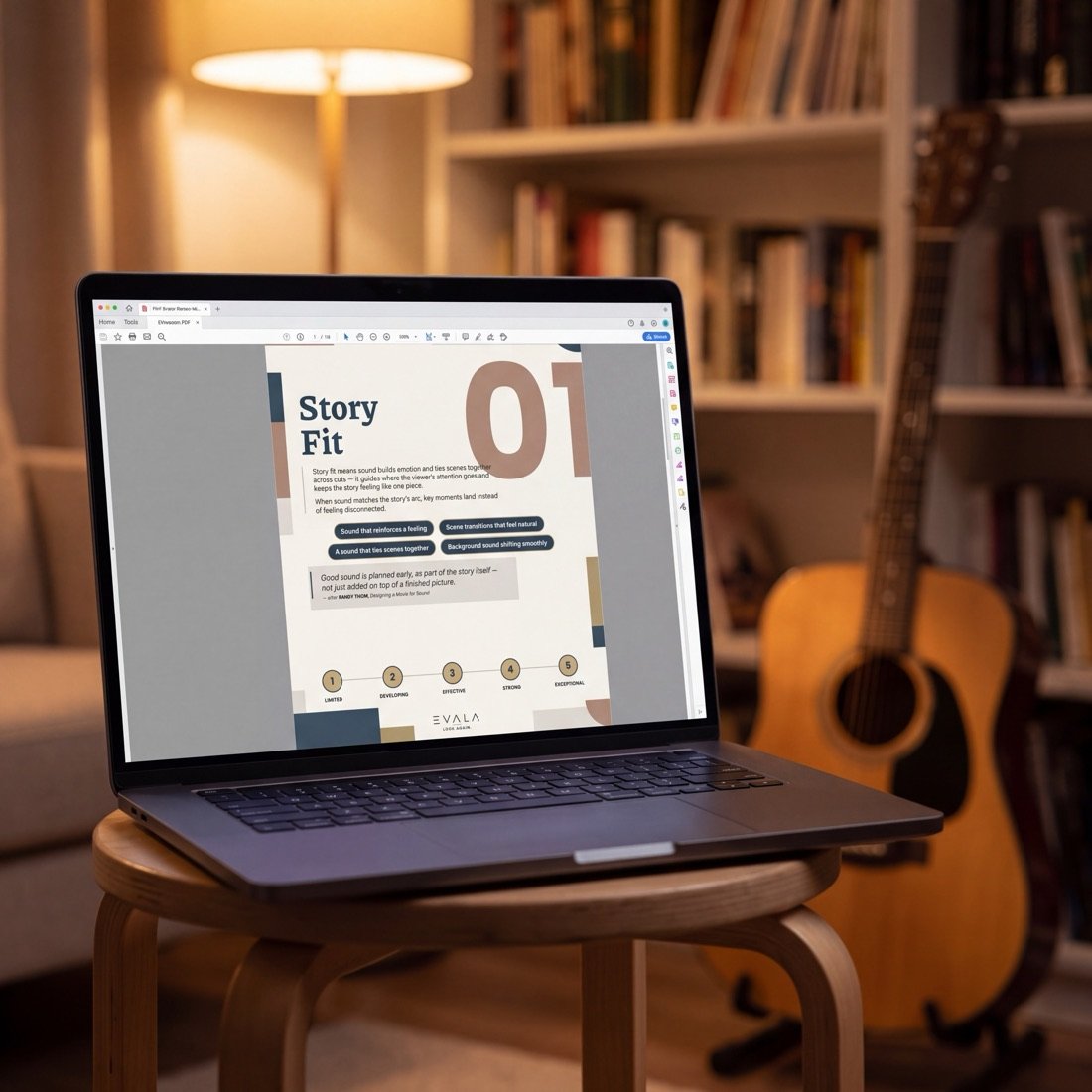
The guide comes as a PDF and an online edition.
- The PDF is fillable. Pick a rating on each concept and the score summary fills in.
- Automatic scoring works in Adobe Acrobat and Acrobat Reader. Other viewers let you fill in the ratings but do not add them up.
- The online edition reads well on a phone or a laptop.
- Every page prints in color or black and white.
- The score helps you compare drafts. It does not decide whether a mix is good.
- Expert quotes are paraphrased and credited “after” the author.
Questions
Before you buy.
Anything else, write to lookagain@evalafeedback.com.
What is the EVALA sound design guide?
It is a feedback framework for sound design, sold as a PDF with an online reading edition. It covers ten concepts. Each has an introduction, a checklist of things to look for, a short explanation of why it matters, a paraphrased expert view and a 1 to 5 rating scale.
Is anything free?
Yes. The Fast Check is a free one-page version, sent to your email. The first two concepts are also on this page in full, and the online preview lets you read them the way buyers do.
What do I get when I buy it?
All ten concepts as a fillable PDF with a score summary page, plus a link to the online edition that reads well on a phone or laptop. It is a one-time payment.
Does the score calculate automatically?
In Adobe Acrobat and Adobe Acrobat Reader (free), yes. Most browser and phone PDF viewers let you fill in the ratings but will not add them up, so you would total the ten ratings yourself on the Final Score page. The online edition and printing both work without Acrobat.
Are the expert quotes word for word?
No. They are paraphrased and credited as “after” the author, so you can trace the idea to its source without treating the wording as a direct quotation.
Does a high score mean the mix is good?
No. The score is a way to organize your own judgment and compare drafts of the same mix. It cannot replace taste, context or the director’s intent.
Who made this
Look again at your next mix.
Read the free sample, then get the full guide
for €8.99 when you are ready.
VAT calculated at checkout